STORIES. VOICES. IMPACT. CHANGE.

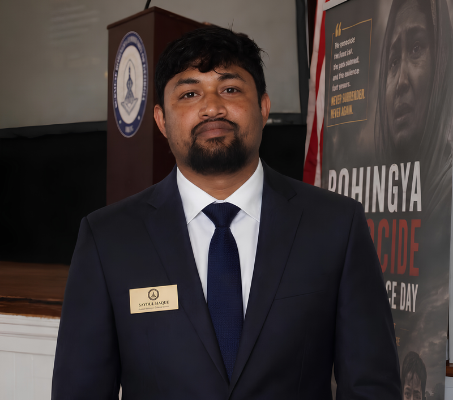
Deputy Executive Director of Burmese Rohingya Community of Georgia
My Journey into Photography and Filmmaking
My journey into photography and filmmaking began with a simple dream: to tell the stories of my Rohingya community through our own eyes.
During the mass displacement of Rohingya people from Myanmar in 2017, my brother, Omar Faruk, and I had opportunities to work with international journalists and media professionals as translators and local media assistants, often known as fixers.
Through these experiences, I realized how powerful photography and filmmaking could be in raising awareness about human rights, humanitarian crises, and the lives of refugees.
I began learning photography, videography, and storytelling through online tutorials, practical experience, and guidance from experienced media professionals.
Over time, photography became more than a personal interest. It became my way of documenting history, preserving memories, and representing the voices of people who are often unheard.
Co-Founding the Rohingya Film School
One of the most meaningful achievements of my journey was helping establish the Rohingya Film School in 2020, alongside my brother Omar Faruk and other passionate Rohingya youth.
We founded this initiative with a shared vision: to empower young Rohingya refugees with the knowledge and skills needed to tell their own stories.
Our goal was to create opportunities for young people who had limited access to formal education, professional training, and creative resources.
Through the Rohingya Film School, we focused on teaching:
● Photography and camera techniques
● Videography and documentary filmmaking
● Video editing and post-production
● Visual storytelling and interviewing
● Community journalism
● Digital media and content creation
● Production of educational videos in the Rohingya language
One of our most important objectives was to produce informational videos in our native Rohingya language so that people living in refugee camps could better understand important issues such as healthcare, hygiene, fire safety, emergency preparedness, and community awareness.
I believe that when refugees are given the tools to document their own experiences, they become more than subjects of news stories. They become storytellers, educators, and advocates for their communities.
Early Life and Background
My name is Saidul Haque. I am a Rohingya photographer, filmmaker, storyteller, and community activist, originally from the Rohingya refugee camps in Cox’s Bazar, Bangladesh.
I was born in 1994 in a refugee camp in Cox’s Bazar, five years after my family was forced to flee Myanmar in 1991. Growing up as a Rohingya refugee, I experienced the challenges of displacement, statelessness, limited opportunities, and uncertainty about the future.
Despite these difficulties, I always believed that our stories deserved to be heard and that our voices should reach beyond the boundaries of the refugee camps.
My childhood experiences shaped my passion for photography, filmmaking, and storytelling. I wanted to show the world not only the suffering of my people but also their strength, dignity, culture, resilience, and hope.
My Humanitarian and Community Work
Throughout my journey, I have been involved in humanitarian communication, photography, filmmaking, and community-based activities.
My work has included engagement with humanitarian organizations such as the International Organization for Migration (IOM) and initiatives connected to the United Nations High Commissioner for Refugees (UNHCR).
Through photography and video production, I have worked to document the daily realities of refugee life, including the challenges faced by families, children, women, and young people living in the camps.
My storytelling focuses on humanitarian issues, education, cultural identity, community resilience, and the hopes of displaced people.
I believe visual storytelling is not simply about taking photographs or recording videos. It is about preserving truth, sharing experiences, and creating understanding between communities.
Preserving Rohingya Culture and Identity
As a Rohingya storyteller, I believe our language, traditions, history, and cultural identity are essential parts of who we are.
For generations, the Rohingya people have faced persecution, displacement, and discrimination. Many of our stories remain undocumented or are told by people outside our community.
Through my photography and filmmaking, I aim to preserve our cultural heritage and ensure that future generations understand their roots.
My work seeks to capture the everyday beauty of Rohingya life, the determination of young people, the strength of families, and the traditions that connect us to our homeland.
I want the world to recognize that Rohingya people are not defined only by their suffering. We are a community with talent, creativity, dreams, history, and dignity.
My Life and Community Involvement in the United States
After spending much of my life in the refugee camps of Bangladesh, I began a new chapter of my journey in the United States.
Today, I live in Georgia, United States, where I continue my passion for photography, filmmaking, storytelling, and community engagement.
I actively participate in activities involving as Deputy Executive Director of the Burmese Rohingya Community of Georgia (BRCG), documenting community gatherings, cultural programs, youth activities, sporting events, and remembrance programs.
I believe community engagement is essential for preserving our identity and strengthening unity among Rohingya families living outside our homeland.
Through my involvement, I aim to encourage young Rohingya people to develop their talents, pursue education, embrace their cultural heritage, and become positive contributors to society.
My Commitment to Rohingya Human Rights and Advocacy
As someone who was born and raised as a refugee, I understand the importance of human rights, justice, education, and the right to live with dignity.
My experiences have inspired me to use storytelling as a tool for awareness and advocacy.
I believe the Rohingya people deserve recognition, equal rights, citizenship, safety, and the opportunity to return voluntarily to their homeland in Myanmar when conditions allow them to live in peace and dignity.
Through my creative work and community involvement, I hope to contribute to greater international understanding of the Rohingya crisis and the challenges faced by displaced communities.
I also believe that younger generations have an important responsibility to preserve our history and carry our stories forward.
My Vision for the Future
My dream is to continue growing as a photographer, filmmaker, and storyteller while creating opportunities for young people in my community.
I hope to develop meaningful documentaries, educational films, cultural projects, and community-based media initiatives that bring positive change.
I also want to continue supporting the mission of the Rohingya Film School and encouraging young Rohingya storytellers to use their creativity and voices to represent their own experiences.
I believe that a camera can do more than capture an image. It can preserve history, challenge misconceptions, inspire change, and give a voice to people whose stories might otherwise be forgotten.
My mission is simple: to tell the stories of my people, preserve our identity, empower the next generation, and ensure that the voices of the Rohingya community continue to be heard around the world.